

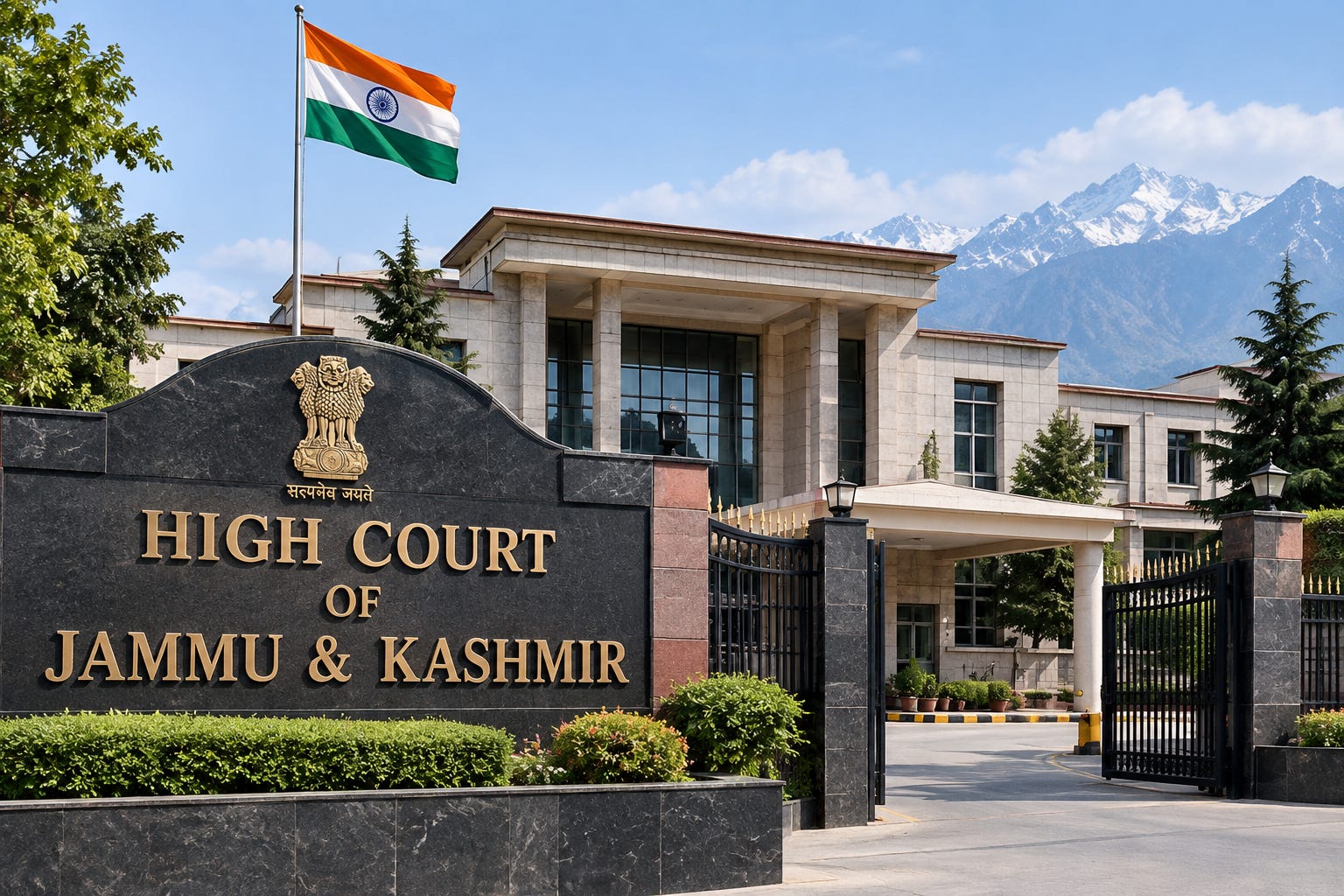
SRINAGAR: Can a government detain a person without trial over the books on their shelf, or because of who their father once was? On September 2, the Jammu and Kashmir and Ladakh High Court unequivocally answered that it cannot.
Quashing the detention of Kupwara academic Shafat Maqbool Wani, Justice Moksha Khajuria Kazmi held that mere possession of books with “dispiriting titles” does not make a person a criminal and, in the same judgment, dismissed the state’s claim that Wani had “inculcated” a separatist ideology because his father was a militant who surrendered thirty-five years earlier.
Together, the two findings amount to one of the more explicit judicial rejections in recent memory of detention for a suspected belief rather than a proven act. The court has stamped a bar on what academics call “thought crime.”
The ruling comes just over a year after the J&K Home Department banned the circulation of 25 books about Kashmir, including works by Arundhati Roy, A.G. Noorani, Anuradha Bhasin and Sumantra Bose, alleging they spread a “false narrative” and promoted “secessionism.” Wani’s case did not concern only that specific list, but it tested the same underlying premise - that a book, or an author’s presumed sympathies, can itself be treated as evidence of a security threat. The High Court’s answer was a direct no.
Wani was detained on September 13, 2025, under order No. 27-DMK/PSA of 2025, issued by the District Magistrate, Kupwara, under the Jammu and Kashmir Public Safety Act (PSA), 1978, to prevent him from “indulging in activities detrimental to the security of the State.”
The habeas corpus petition against the order was filed by his paternal uncle and argued by advocate Zahid Hussain Dar; the Union Territory was represented by Government Advocate Faheem Nisar Shah. The detention rested on three pillars: literature seized from his home, his family background, and his alleged involvement in a 2025 FIR. The court dismissed each.
Ground one: Books are not evidence of secession
Police described literature recovered from Wani’s residence as “anti-national” and attributed two titles to him as author: Construction of an Islamic Order in Hindutva Reimagination and The Saffronisation of Occupied Kashmir: Demystifying Hindutva Settlers, Colonial Designers. The court found this attribution simply wrong. Wani, it held, had not written either book.
The more consequential finding was that even if the books had been his, that would not have settled the matter. Being “an academic scholar,” the judgment observed, Wani was “expected to be in possession of variety of literary means,” and mere possession of books “with dispiriting titles does not ipso facto make the petitioner/detenue a criminal against whom the preventive detention was required to be invoked.”
In a single sentence, the court separated the act of owning or engaging with contentious ideas from the act of committing a prejudicial one. The court noted, further, that no subversive activity of any kind had been shown against Wani independent of the seized literature and the FIR.
Ground two: Guilt is not hereditary
The state’s second plank was Wani’s ancestry. The grounds of detention claimed he had “inculcated” anti-India and separatist feelings “since his childhood” because his father was a former militant affiliated with the outfit Al-Barq, who surrendered in 1990 - thirty-five years ago and effectively a generation before the detention order was signed.
The court called this “delusory,” holding that detention “ordered so conveniently on such imaginary belief, is nothing but an unmindful exercise of power.”
It anchored the finding in the Supreme Court’s 2023 ruling in Ameena Begum v. State of Telangana, (2023) 9 SCC 587, which requires a detaining authority’s satisfaction to rest on a “live and proximate link” between a person’s own past conduct and the need to detain them. It does not rest on conduct, or belief, inherited from a parent decades removed.
Beyond the FIR itself, the court noted, “no prejudicial activity even for namesake” had been attributed to Wani anywhere in the grounds. The grounds interestingly cited Wani’s invitations to present at international academic conferences at Columbia University and Dublin City University, flagging these as a marker of concern, without ever explaining what was objectionable about them.
Ground three: A bail order reversed
The third infirmity was procedural, and in some ways the most damning. Wani’s detention rested almost entirely on FIR No. 69/2025, registered at Police Station Handwara under Section 7/25 of the Arms Act and Sections 13, 17 and 18 of the Unlawful Activities (Prevention) Act (UAPA). But he had already been granted bail in that case by the Special Judge, NIA, Jammu, after the National Investigation Agency’s plea to extend his remand beyond 155 days was rejected on September 8, 2025.
The bail order and the detention order carry the same date - September 13, 2025. The detaining authority acted the very day the court set him free. The respondents in their own counter-affidavit acknowledged the bail and re-arrest on the same day, but the court held that acknowledging a fact and reckoning with it are different things. The detaining authority, it found, “does not appear to have made any effort to derive satisfaction as regards the prejudicial activity” that would justify overriding a judicial bail order through executive detention.
Amnesty International has tracked the same pattern across Jammu and Kashmir for well over a decade, describing it as a “revolving door” policy. Authorities re-arrest a person - sometimes under an entirely different law, sometimes on a freshly filed FIR - the moment a court grants bail, or even before release has actually happened. The term traces to Amnesty’s 2011 report on the PSA, which accused Jammu and Kashmir authorities of using the law to hold onto people they could not, or would not, convict through the ordinary courts.
A follow-up Amnesty investigation into 210 PSA cases between 2012 and 2018 found 71 fitting this description - cases where a fresh detention order or a new FIR followed close on the heels of a bail grant - and reported that nine in ten of the detainees studied faced PSA detention and ordinary criminal proceedings running in parallel, over the very same allegations.
The researcher who led that study summed up the tactic as police treating the PSA as a fallback, ready to hold a suspect the instant a court frees them, or looks likely to. Wani’s case, with its bail order and detention order sharing a single date, fits into that pattern.
Why this ruling stands out
J&K’s High Court quashes PSA detentions often enough that the exercise has become almost routine.
The same week as Wani’s ruling, two other benches quashed PSA orders on comparable facts elsewhere in the Valley - a Pulwama case decided that same day, and a Baramulla case decided by Justice Kazmi herself.
What sets Wani’s case apart within that pattern is substantive. Unlike most PSA detentions quashed where court relies on procedural elements reproduction of a police dossier, unexplained delay, stale material and mistaken identity, Wani’s ruling found the underlying theory of guilt untenable.
It held categorically that neither an inherited ideology nor a seized bookshelf can substitute for a proven act. That distinction is what makes this more than a routine quashment order. It is a landmark verdict that questions the limits of preventive detention, delivered squarely inside a live political controversy over book bans.
What, however, it does not erase is this: Wani has already spent in custody since September 2025 – waiting for a process that was a punishment. PSA detainees elsewhere in J&K have, in other reported cases, remained jailed for weeks, even years after a court ordered their freedom.
Breaking silence is a collective responsibility. While we disrupt propaganda networks, amplify marginalized voices, challenge entrenched power structures and defend democracy, your support is a moral imperative. Every contribution is a defiant act against willful ignorance, a declaration that truth matters more than comfort.
Will you be complicit in silence, or will you become a guardian of truth?
https://www.gofundme.com/manage/jammu-kashmirs-sole-independent-voice-under-threat
—